






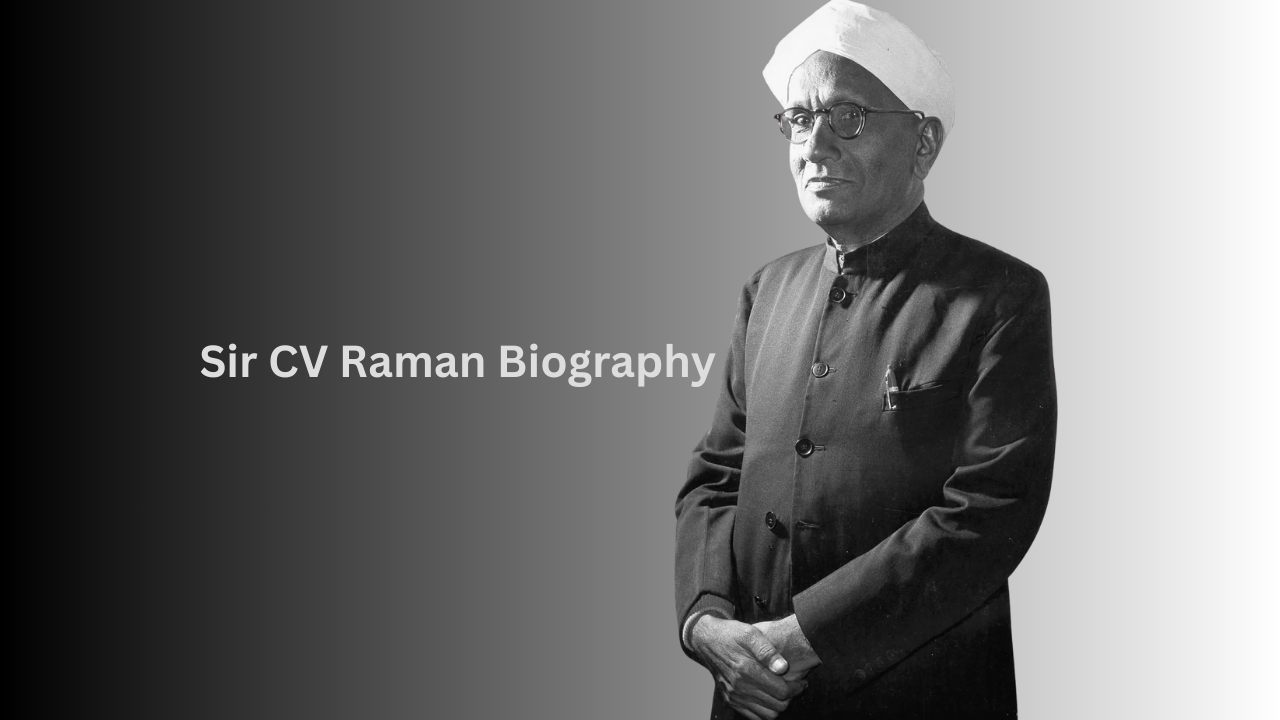
The man behind light The science of Sir Chandrasekhara Venkata Raman, fondly known as C. V. Raman, India’s most illustrious physicist who changed the way the world sees light is not just a scientist but an enterprise of curiosity folded in simplicity. He demonstrated to the world that cutting-edge science doesn’t always require huge laboratories, and it isn’t always about isolating biochemical compounds or molecular structures; sometimes it just requires a brilliant brain and unstoppable perseverance.
Why C. V. Raman Still Matters Why?
Decades after his breakthrough, Raman’s legacy still colors modern science, from chemistry labs to medical diagnostics. His thoughts led to technologies we rely on every day and never even think about.
His Scientific Legacy in Brief
C. V. Raman was the first Asian to be awarded a Nobel Prize in Physics and his discovery brought light-matter interaction into focus for science forever.
Early life and childhood
Birth and family background
C. V. Raman was born on 7 November 1888 in Tamil Nadu, India. His father was a lecturer in physics and mathematics, so science was frequently the subject at home.
Early Signs of Brilliance
Raman was an extremely clever child from the beginning. He was inquisitive rather than playful, more likely to be found in books while other boys were at play.
Education and Academic Journey
Schooling and College Life
Raman, who finished his schooling somewhat early, entered Presidency College at Madras and there took his B.Sc., as well as M.Sc. degrees in physics with the first rank for every degree.
Admission to the Realm of Science
His papers already started to be published in well-known journals as a student, this milestone heralded the entrance of a scientific phenomenon.
Career Beginnings
Civil Servant and Scientist
Weirdly, Raman donned the hat of a civil servant in India’s Finance Department first. But science was his vocation.
Balancing Job and Passion
He performed experiments in the early morning and late at night—proof that passion isn’t beholden to permission.
The Raman Effect – A Groundbreaking Finding
What Is the Raman Effect?
Raman Effect: the shift in wavelength of light when it passes through to a transparent material and causes excitation of the molecules within.
How Raman Discovered It?
In 1928, with basic tools, Raman noticed that the color of scattered light shifts — a finding that astonished scientists.
Scientific Explanation in Simple Words
Imagine light as a ball bouncing off molecules. Sometimes, it loses or gains energy during the bounce. That tiny energy shift is the Raman Effect.
Theories and Scientific Contributions of C. V. Raman
Theory of Light Scattering
He described how light interacts with molecules, showing that scattering isn’t random — it follows physical laws. Molecular Vibration and Energy Levels his theory revealed that molecules vibrate at certain energy levels, which influences how light scatters.
Raman Spectroscopy Theory
This theory formed the template from which, in 1928, Raman Spectroscopy eventually evolved – a method of identifying the composition of substances by looking at changes in the light they scatter.
Contributions to Acoustics
Raman researched sound waves, musical acoustics and the behavior of vibrations in various materials.
Work on Musical Instruments
In his music, he explored the physics of Indian instruments like the tabla and mridangam, a mixing of culture and science. Significance of the Raman Effect in Contemporary Science
Importance of the Raman Effect in Modern Science
Applications in Chemistry
Raman spectroscopy helps chemists identify compounds without needing to destroy samples.
Applications in Physics
It is useful for the crystal structures, semiconductors and nanomaterials investigation.
Use in Medical Science
Doctors use it to detect cancer, study tissues and develop drugs. Nobel Prize and Global Recognition Nobel Prize in Physics 1930 Raman for his discovery of Raman Effect, thereby bringing acclaim to India in the International arena.
Nobel Prize and Global Recognition
Nobel Prize in Physics 1930
Raman won the Nobel Prize for discovering the Raman Effect, making India proud on the global stage.
International Fame and Honors
He received numerous honors, including knighthood from the British government.
Role in Indian Scientific Development
Establishment of Research Institutions
Raman played a key role in building India’s scientific ecosystem, including the Raman Research Institute.
Promoting Science in India
He inspired generations to pursue science with confidence and originality.
Raman as a Teacher and Mentor
Teaching Philosophy
Raman believed curiosity was more important than memorization.
Influence on Young Scientists
Many of India’s top scientists credit Raman as their inspiration.
Read Also: Hiba Nawab Biography | Shivangi Joshi Age | Kabir Bahia Age
Personal Life and Character
Personality Traits
Raman was certain, emboldened and occasionally contraversial — but always forthright.
Love for Indian Culture
He had great admiration for Indian tradition and felt that science to live simultaneously together with culturefulfilling a person’s life.
Challenges and Criticism
Scientific Rivalries
Raman was criticised by Western scientists who failed to believe his work at the first instance.
Professional Conflicts
His strong views provoked occasional clashes, but he never played fast and loose with the truth.
Legacy of Sir C. V. Raman
National Science Day
National Science Day is celebrated in India on 28 February each year, in Raman’s honour.
Raman’s Impact on Future Generations
His life’s work has lived on as a source of inspiration for students, scholars and innovators.
Conclusion
Sir Chandrasekhara Venkata Raman was not just a Nobel laureate; he represented intellectual fearlessness. His theories changed our understanding of light, matter and sound. In a world hell-bent on instant gratification, Raman reminds us that the real magic of discovery is found in curiosity, patience and fearless thinking.
FAQs About Sir C. V. Raman
Q.1 Who was Sir C. V. Raman?
Indian physicist who was the first to observe the Raman Effect and received the Nobel Prize for Physics in 1930.
Q.2 What is the Raman Effect?
It is the wavelength shift of light due to scattering through a participating medium.
Q.3 Why is Raman Spectroscopy important?
It allows you to recognize chemicals, and is used commonly in veiled science and medicine.
Q.4 When is National Science Day observed?
It is observed annually on 28 February in India.
Q.5 What were Raman’s major theories?
His prominent contributions are in the fields of light scattering, molecular vibration, acoustics and Raman effect.
Read Also: Pranjal Dahiya Husband Name | Acharya Prashant Net worth